
Free Initial Consultation on Injury Cases 704-377-5242
North Carolina Eminent Domain Attorney
Trusted Eminent Domain Lawyer in North Carolina, NC
Owning your own piece of property can be a sign of accomplishment. Whether newly acquired or passed down through the generations, residential or business property can be a great reward for hard work. However, there is a misconception that our property is strictly ours and that no one may interfere with it, so long as we own it. For residents experiencing a North Carolina eminent domain situation, this can leave an uneasy feeling about land that they thought was solely theirs.
Unfortunately, the Fifth Amendment to the United States Constitution provides the government with the right to take land from property owners for the benefit of public use as long as they provide just compensation.

DAS Law Group: NC Land Condemnation Attorneys
At DAS Law Group, our attorneys know that property owners still have rights that allow them to defend themselves against such practices. While property owners cannot outright refuse the process, there are steps that our attorneys can help with. Our firm can work hard to either pursue proper compensation for your property or deter the process altogether.
Is Eminent Domain Legal in North Carolina?
Eminent domain is a legal practice afforded to state and federal government entities, along with corporate utility companies. It allows them to take property owned by individuals and citizens to redevelop it into an area for public use. To obtain the property, the government must show proof that the land can be used for any number of public projects, such as:
- Transportation, like roads, highways, or bridges
- Infrastructure, such as public works buildings
- Expanding or assisting with the water supply
- Building a public park
- Enhancing environmental protection
- Preserving a historical site
- Usage for military practices, power infrastructure, utilities etc.
This list is certainly not exhaustive, but it provides a representation of the types of projects that the government may seize land for. Unfortunately, there are many cases where the land is taken with good intentions, only to end up owned by private corporations or entities.
The right to take this land, however, is protected by both state and federal laws, including the Constitution of the United States. The Fifth Amendment states that private property shall not be taken without proper compensation. Under this amendment, both the necessity of the land for public use and the provision of appropriate compensation must occur for the government to successfully use eminent domain. It is these two areas in which a property owner can defend themselves against policies that may be unjust.
Looking at the Impact of Eminent Domain Laws in NC
Eminent domain cases are very difficult to combat, given the Supreme Court’s ruling in the case of Kelo v. New London in 2005, which provided that eminent domain can be used to acquire land that, in turn, could be used for private development. This was because the government argued that using the land for private use would generate additional economic stimulation in the area.
Legislators in North Carolina sought to prevent this from happening to the state’s citizens, so they passed a state House bill to protect them. It countered all state and local laws that allowed eminent domain to be used to secure land for a business under the argument that it would improve the economy. The case also highlighted the problems associated with how eminent domain claims begin. Homes and property must be condemned for the eminent domain claim to move forward.
The case also highlighted the problems associated with how eminent domain claims begin. Homes and property must be condemned for the eminent domain claim to move forward.
However, because Kelo v. New London was supported for financial reasons, it basically made the case that any business that wasn’t as economically successful as another business could be condemned by the government to make room for a more lucrative entity. Nevertheless, the property in question may not fit the definition of condemned that many would agree with.
What Is the Process for Eminent Domain in North Carolina?
Once the decision has been made by the government to begin an eminent domain case, they can begin by announcing the project and the location where it may take place. This might be done prior to the landowner being contacted, though that may soon follow the announcement. An inspector would then visit the property to determine the value of the land through an appraisal process. After this, an offer may be made to the homeowner based on what is believed to be the fair market value.
The next step can seem a bit confusing because, as a landowner, you can accept or reject the offer that you received. However, rejecting the offer does not mean that the property will not be taken. When the owner rejects the offer made by the government, the land can still be taken and the offer is simply placed into an escrow account until the transaction is settled, at which point the landowner is paid.
A rejected offer, however, allows the property owner time to challenge the eminent domain claim on one of two grounds:
- They can assert that the land might not be for public use, making the case that it may be used for private business instead.
- They can contest the offer made for the land, showing that it was below the property’s fair market value.
Should you counter the offer made by the government, your attorney may ask that the transaction be reviewed by a commission, which could either reinforce the claim that the offer is valid or provide an alternative settlement.
If the offer is still not acceptable to the property owner, they have the right to challenge the eminent domain claim in court. Unfortunately, most eminent domain claims are not preventable. Filing a claim in court against it may only yield a greater settlement to the landowner.
An Example of Securing a Fair Settlement for Condemnation
It can be helpful to look at a real-life example of eminent domain to understand the compensation aspect of land condemnation. One of the more common reasons a government agency seeks to acquire land for public use is to develop roadways. In trying to secure real estate for their I-26 Connector project, the North Carolina Department of Transportation (NCDOT) has been shown to offer property owners much lower amounts than what the final settlements end up being.
It was found that the average appraisal value of acquired land for this project was $156,581, according to NCDOT, while the average settlement was $195,936. This is a 25 percent increase compared to the appraisal provided by the government. That’s one example of why it is critical that you work with a qualified and experienced eminent domain attorney. They can pursue fair compensation for your condemned property.
Understanding Court Proceedings for Eminent Domain Cases
If you and the authority seeking to condemn your property cannot reach an agreement regarding the compensatory settlement amount, the condemning party may then file a claim in the county where said property is located. In North Carolina, it is required that both the real estate owner and the condemning authority participate in mediation when a compensation agreement cannot be reached.
During mediation proceedings, a neutral third party assists the property owner, the government representative, and their respective legal counsel in settling the matter. If your legal representation can prove that the taking of the real estate would not be for the public benefit, the seizure would be determined to be unlawful, and the case may be dropped.
However, even if condemnation is justifiable for a public purpose, your attorney can still present evidence arguing that your property is worth more than the amount initially offered by the government. If the matter of compensation cannot be resolved during mediation, the case then goes to court to be decided by a jury.
Partial Condemnation
It is also possible that you are subject to a partial taking, which means not all your property will be subject to the condemnation action. Our attorneys can navigate the process of a partial taking, particularly when the land that remains after the taking is significantly reduced in value. Furthermore, it is possible that what one entity claims is only a partial taking is actually a complete taking.
Why You Should Hire an Eminent Domain Lawyer for Your Case
Some may be inclined to try handling an eminent domain case without an attorney. They think it can save them money, especially when they were forced into the situation in the first place. However, when the forces arrayed against you seem insurmountable, it is even more important to hire an eminent domain lawyer so you can have the legal representation you deserve.
Attorneys who litigate eminent domain cases understand the challenges associated with them, and they work hard to advocate for their clients. The attorney’s priority is to see that their client’s interests are not being taken advantage of. They can tell if:
- The compensation that was offered is unfair.
- The government is attempting to seize property for reasons other than the public benefit.
Attorneys know that the goal of the government or the representing agency is to gain the property for as little as financially possible, so a skilled attorney may start your case by challenging this. By using their extensive resources, such as real estate agents, property appraisers, and other industry professionals, they can research the property, documents, and history to look for comparable properties that may increase the settlement value.
Although there are ways to research this information independently, unfortunately, the entities you are arguing against may be vast and have their own team of professionals ready to counter your efforts. Such entities and their professionals know these common issues and can work to prevent them.
The eminent domain process is designed to create a more favorable outcome by:
- Fairly appraising the property with independent parties
- Checking that the compensation reflects not only the value of the land but also anything that is impacted by the acquisition
- Working with others who can provide testimony and evidence as to the value of the land
How North Carolina Property Owners Can Use the State Transportation Improvement Program (STIP)
The North Carolina Department of Transportation maintains a powerful tool known as the State Transportation Improvement Program (STIP). The STIP is a long-range planning document that outlines transportation improvement projects that are reasonably expected to be funded in the next decade.
Anyone with property near major transit paths in rapidly expanding cities, including Charlotte, Huntersville, Cornelius, Matthews, Concord, and Gastonia, would benefit from consulting the STIP. Its entries can provide an early alert about potential future developments impacting adjacent real estate.
By periodically taking a few minutes to review the STIP, property owners can get a head start on identifying potential projects that may require additional right-of-way access later. They can also begin watching for the telltale signs that an offer may be coming soon.
The Legacy of North Carolina’s Map Act
Back in 1987, North Carolina passed a law, known as the Map Act, that allowed NCDOT to file transportation corridor maps near where it intended to expand or build new highways. Once the map was filed with the county, affected property owners were frequently restricted from developing, improving, or subdividing their land.
Sometimes, property owners found their ability to use their land restricted for many years, as the NCDOT considered whether to move forward with a proposed project. Property owners received no compensation for these limitations on their property rights.
The case eventually went to the North Carolina Supreme Court. In 2016, the Map Act restrictions were found to be a taking of private property in violation of constitutional rights in the case of Kirby v. North Carolina Department of Transportation. Since then, transportation corridors must be planned differently, once again solidifying that governments can’t put private property off-limits indefinitely.
For North Carolina landowners, especially those residing close to major transit routes, like those around Charlotte, Raleigh, Greensboro, and Wilmington, the Map Act serves as a key illustration of eminent domain and property rights’ evolution.
Understanding Right-of-Way Agents
When your property is being considered for eminent domain, the first person you may speak with is a right-of-way (ROW) agent. These individuals are usually working for NCDOT or another private company hired to help the government acquire land.
Once the project is underway, a ROW agent may get in touch to explain things, arrange for an appraisal and inspection, and discuss acquiring the property rights you own. While many of these agents are professional and kind, it’s important to remember that they work in the government’s interests.
The ROW agent represents the entity purchasing the land, tasked with securing the necessary property for the project while staying within budget. The agent wants to collect as little money as possible while closing on your property in a timely manner. For this reason, don’t hesitate to look over any documents, values, or settlement offers they negotiate on your behalf.
Temporary and Permanent Easements in North Carolina
Eminent domain doesn’t always mean the taking of property. Oftentimes, in North Carolina transportation projects, NCDOT may only need a temporary construction easement or a permanent easement instead of the outright ownership of your property.
For instance, NCDOT might only need to grant construction crews access to half of your property to complete a road widening project through a temporary easement before the property rights revert to you.
However, a permanent easement can stay with your property forever and limit how you can use that portion of your land in the future. If you own property along the I-77, I-485, or U.S. 74 corridors, be sure to read any proposed easement carefully, as it could affect your property long after the construction crews leave.
What If My Business Would Be Affected by Eminent Domain?
In an eminent domain case that impacts an operating business, you should know that the compensation package does not include money for your business. The value of your business is not taken into account; only the value of the land. However, in some cases, an attorney can argue that you deserve additional compensation to help with relocation costs. While not guaranteed, your lawyer could argue for some additional compensation for the structure itself.
To find out more about whether your business and its cost of operations may be relevant in an eminent domain matter, be sure to consult a qualified attorney with experience in land condemnation laws. It can be undoubtedly stressful and overwhelming, trying to navigate eminent domain laws while trying to keep your business running. That’s why it’s highly advised that you entrust your case to a legal professional who understands how to effectively represent you.
What to Know About DAS Law Group
If you are in search of a knowledgeable and skilled NC land condemnation attorney, look no further than the attorneys at DAS Law Group. Our eminent domain law firm, based in Charlotte, is committed to providing each client with efficient yet effective legal counsel. We can advocate on your behalf with comprehensive and high-quality representation, tailored to your unique needs and goals.
An eminent domain case in North Carolina is most likely to be processed by the courthouse of the county in which the real estate is located. For example, a land condemnation matter in Charlotte would most likely be overseen by the Mecklenburg County Superior Court. The Mecklenburg County Courthouse is located at 832 East 4th Street, Charlotte, NC 28202. The legal venue can vary, depending on your case, so be sure to confirm with your attorney which courthouse may be relevant to you.
FAQs
Does North Carolina Have Eminent Domain?
Yes, North Carolina does have eminent domain. Eminent domain is a legal process wherein local and federal government entities can take privately owned real estate from citizens to redevelop it for public use.
However, for a government agency or corporate utility company to acquire the land, it must meet certain requirements, including proving that the land is for the public benefit and providing compensation to the landowner.
What Are the Three Requirements for Eminent Domain?
The three requirements for lawful eminent domain are:
- The taking of land must be for public use or purpose.
- The property owner must be given “just compensation,” or fair market value, for the land.
- The condemning authority must follow due process, including giving property owners formal notice, the chance to be heard, and the opportunity to challenge the acquisition.
Property owners can argue that it isn’t for the public’s benefit or that the compensation offered is insufficient.
What Are Common Reasons for Eminent Domain in NC?
In North Carolina for eminent domain to be exercised by the government, it must be for the public’s benefit. This means that seizing a property for any reason other than public use or purpose is considered unlawful. Common reasons for eminent domain include:
- Building Public Facilities: such as hospitals, schools, libraries, police stations, etc.
- Developing Public Utilities: including pipelines, water lines, electrical grids, and more
- Transportation Infrastructure: such as the construction of roads, highways, bridges, airports, etc.
What Is the Process for Eminent Domain in North Carolina?
In North Carolina, the eminent domain process begins when a property owner receives a notice from the government, saying that their land is needed for a public project. This notice may be in the form of a letter or a right-of-way agent. The next step is for an offer to be made. The government may conduct an appraisal of the land to determine just compensation, but landowners have the right to refuse this initial offer.
Do I Need an Eminent Domain and Condemnation Lawyer?
While you’re not required to work with an eminent domain and land condemnation lawyer, it is strongly recommended that you do so for several reasons. An eminent domain attorney is experienced in the process, so they can avoid errors and streamline it.
Your lawyer can also verify that the government is following due process requirements, including that you are fairly compensated for your land. If the offer is insufficient, your attorney can argue for more on your behalf.
Contact a North Carolina Eminent Domain Attorney
If you or your loved one is on notice from the government that they are seeking to acquire your property, speak with an attorney as soon as possible. Do not accept any offers or contact the government prior to doing so. You deserve representation from the beginning to assert your rights as a property owner.
At DAS Law Group, our attorneys understand that you deserve this protection, and we put our clients’ interests first. With our experience, we can challenge the shortcomings of the eminent domain process. Our firm can push for fair treatment and just compensation for what you worked so hard to obtain. We can investigate the condemning authority’s stated reasons for taking your property, compare their offer against fair market values, and advocate for the outcome you need.
No matter where you live in North Carolina, our firm can support you. Contact our offices today to speak with one of our lawyers.

request your consultation
* We encourage prospective clients not to use AI research or drafting software in submitting their intake, as that can lead to unintended rejection via our spam filter.
"*" indicates required fields
our location
call us now 704-377-5242
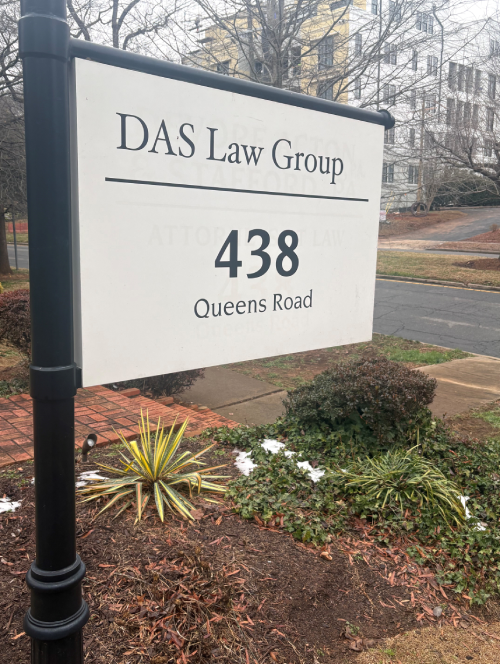
office location
DAS Law Group
438 Queens Road
Charlotte, NC 28207
fax:
704-332-2825
Copyright © 2026 DAS Group, LLP. All rights reserved. Disclaimer | Site Map | Privacy Policy
*Images are obtained under license from Canva and other third-party stock image providers, with attribution included where required.
Digital Marketing By 