
Free Initial Consultation on Injury Cases 704-377-5242
North Carolina Commercial Condemnation Lawyer
Experienced Commercial Condemnation Attorney in North Carolina, NC
If the government has targeted your business property, you need someone who knows how to push back. A North Carolina commercial condemnation lawyer can challenge low appraisals, identify damages the government conveniently overlooks, and pursue fair compensation. At DAS Law Group, we have handled these cases across the state, and we know the difference between what the government offers and what property owners are actually owed.
Commercial condemnation, the government’s forced acquisition of privately owned business property, is authorized under both the Fifth Amendment and North Carolina General Statutes Chapter 40A. The law states you are solely entitled to compensation. However, that’s left up to interpretation, and the government’s interpretation almost never favors you.
Knowing your rights under commercial condemnation law prior to responding to any offer is one of the most important steps you can take.

What Makes Commercial Condemnation Cases Different?
Commercial properties are harder to value than residential ones, and the government’s appraisers know it. Under N.C. Gen. Stat. § 40A-64, just compensation is pegged to the fair market value of the property immediately before the taking. For commercial real estate, though, that figure rarely tells the whole story.
Lost business profits are not recoverable in North Carolina. Therefore, it is important to pursue every other avenue of recovery. Categories of damages that you may be able to recover include:
- The fair market value of the full parcel or the affected portion
- Severance damages when a partial taking reduces the value of what remains
- Relocation costs for equipment, inventory, and fixtures
- Compensation for improvements, specialized infrastructure, or site work
With lost profits excluded, the property valuation itself carries everything. That is not a challenge you want to take on without experienced representation.
Who Can Condemn Your Commercial Property in North Carolina?
The most active condemning authority in North Carolina is the North Carolina Department of Transportation. They take commercial and non-residential properties quite frequently for road and highway construction. However, counties, municipalities, utility companies, and others who are permitted by Statute 40A-3 also have this power.
The gap between what the government offers and what property owners can recover is well-documented. For the NCDOT’s I-26 Connector project, the average appraisal came in at $156,581, while the average final settlement reached $195,936. A separate analysis of Division 13 acquisitions found that negotiated settlements in 2021 averaged 154% above the approved appraisal. These are not outliers. They reflect what happens when property owners push back.
Hire a Commercial Condemnation Lawyer Before You Respond to an Offer
If you agree to the government’s offer, the case is over. This is why it’s important that you hire a commercial condemnation lawyer to review anything before you sign. By retaining an experienced North Carolina commercial condemnation attorney from the outset, you have the opportunity to obtain an independent appraisal, uncover damages the government has overlooked, and negotiate from a position of strength.
DAS Law Group has fought for property owners all over North Carolina in eminent domain and condemnation cases. Our lawyers have over 100 years of combined civil trial experience, and our firm has developed condemnation law in the state by arguing over 75 appellate cases in the North Carolina Court of Appeals, North Carolina Supreme Court, and Fourth Circuit Court of Appeals.
Attorneys from around the state refer their clients to us when they know it matters most. When you choose DAS Law Group for your commercial condemnation case, you can rest assured that you have lawyers who have been there before. The outcome of any given case cannot be guaranteed and will always depend on its unique facts.
FAQs
What Happens to Commercial Tenants When a Property Is Condemned?
When a commercial property is condemned, tenants are sometimes entitled to compensation separate from what the property owner receives. Depending on the terms of the lease and the nature of the taking, a tenant could have a claim for relocation costs, the value of improvements they made to the space, or loss of their leasehold interest.
Both the property owner and any tenants should seek independent legal counsel, as their interests in a condemnation case are not always aligned.
Can You Negotiate the Compensation Amount After a Condemnation Filing in North Carolina?
In North Carolina, you can negotiate the compensation amount even after the condemning authority files a complaint in Superior Court and deposits its estimated compensation. The case is still not closed. Property owners retain the right to challenge the amount through negotiation, mediation, or a jury trial under N.C.G.S. § 136-112.
Accepting the deposited funds does not waive your right to pursue additional compensation. Many commercial condemnation cases settle for more than the initial deposit during this litigation phase.
How Long Does a Commercial Condemnation Case Take in North Carolina?
The timeline for condemnation varies depending on the complexity of the valuation, how far apart the parties are on compensation, and whether the case proceeds to trial. Some commercial condemnation cases resolve within several months through negotiation. Cases that go to jury trial can take a year or longer.
Factors like the size of the property, the number of compensable interests involved, and whether expert appraisers disagree significantly can all affect how long the process takes.
Can the Government Condemn a Commercial Property That Is Still Actively Operating?
The government can condemn commercial properties regardless of occupancy or despair. Operating businesses, income-producing properties, and properties under active leases can all be acquired through eminent domain as long as the taking serves a lawful public purpose. When a functioning business is displaced, this context is relevant to how the property should be valued, and certain relocation benefits may be available under state and federal law.
Speak With DAS Law Group About Your Commercial Condemnation Case
If your commercial property has been targeted, reach out to our team before you make any decisions. Contact DAS Law Group today to speak with a North Carolina commercial condemnation attorney who can review your situation and help you pursue every dollar you are owed.
request your consultation
* We encourage prospective clients not to use AI research or drafting software in submitting their intake, as that can lead to unintended rejection via our spam filter.
"*" indicates required fields
our location
call us now 704-377-5242
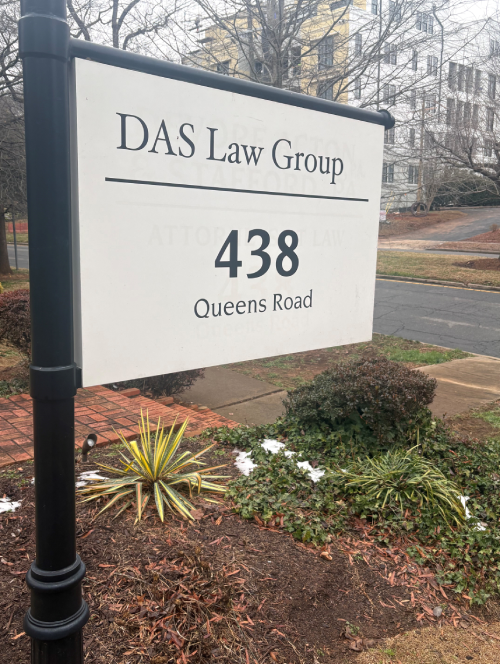
office location
DAS Law Group
438 Queens Road
Charlotte, NC 28207
fax:
704-332-2825
Copyright © 2026 DAS Group, LLP. All rights reserved. Disclaimer | Site Map | Privacy Policy
*Images are obtained under license from Canva and other third-party stock image providers, with attribution included where required.
Digital Marketing By 