


Free Initial Consultation on Injury Cases 704-377-5242
Do You Have To Pay Taxes When Your Property Is Taken By Eminent Domain In North Carolina?

You just got a check for the strip of land the county took to widen the road, or the acre a pipeline company condemned for an easement, and now you’re staring at the number wondering how much is really yours.
Eminent domain compensation is a taxable event under federal and North Carolina tax law, but that doesn’t automatically mean you owe anything. It depends on what you paid for the land, what you were paid, and what you do with the money next.
The attorneys at DAS Law Group have spent decades negotiating condemnation settlements across Mecklenburg County, building the tax picture into the negotiation itself, not after the check clears.
Is Eminent Domain Compensation Taxable in North Carolina?
Yes, an eminent domain payment is a taxable event, treated by the IRS and the North Carolina Department of Revenue the way a home sale would be. That surprises a lot of owners, since nobody chose to sell. A government agency or a utility holding condemnation power, decided your land was needed and paid for it.
A taxable event isn’t the same as a tax bill, though. You only owe capital gains tax if you received more than your adjusted basis, what you paid plus improvements minus depreciation. Plenty of North Carolina landowners walk away owing nothing, simply because the payment barely covers what they put into the property decades ago.
Why the IRS Treats a Taking Like a Sale
Government condemnation forces a transfer of ownership, and federal tax law treats a forced transfer almost like a chosen one. IRS Publication 544 explains it plainly: an involuntary conversion happens whenever property is condemned and you receive money or property in return, with the gain calculated the same way as in a voluntary sale.
How a settlement gets itemized determines what portion is taxed. That means how much is labeled as just compensation, severance damages, or relocation reimbursement. An eminent domain attorney who negotiates that language before the paperwork is signed shapes the outcome instead of reacting to it.
When a Partial Taking Doesn’t Trigger Any Tax at All
Most eminent domain cases around Charlotte are partial takings, like the North Carolina Department of Transportation (NCDOT) shaving 15 feet off a yard to widen a road. Whether that triggers a tax bill comes down to a short list of facts:
- The payment doesn’t exceed your adjusted basis in the property
- Severance damages get applied against the basis of what you kept, not counted as income
- Relocation reimbursements stay untaxed as long as they cover qualified moving and housing costs
- You reinvest any gain in similar property within the hip replacement window
Any one of these can wipe out a tax bill even when the check itself looks substantial.
Deferring the Gain With a Section 1033 Exchange
If your payment creates a gain, Section 1033 of the Internal Revenue Code lets you defer the tax bill entirely. Buy replacement property similar in use to what was taken, within the required window, and the IRS lets you carry your old basis forward instead of taxing the gain now.
The clock matters here. You generally have until the end of the third tax year after receiving payment to close on replacement property. The three-year window only applies if the property was real estate litigation you used for business or held as an investment. If the condemned property was personal-use property, or if it wasn’t real estate at all, the shorter two-year window applies instead.
Additionally, if the property taken was your main home, you may be able to exclude up to $250,000 of the gain from your taxes ($500,000 if you’re married and file jointly) — the same exclusion you’d get if you sold your home voluntarily. This can be more valuable than deferring the gain under Section 1033.
What Happens to Relocation Payments and Severance Damages
Relocation payments almost never show up on a tax return, thanks to the federal Uniform Relocation Assistance Act. That protection reliably covers takings by NCDOT and other government agencies. A private utility using its own condemnation power isn’t automatically covered by the same law, so it’s worth confirming with the utility how its relocation payments are taxed before assuming they’re tax-free.
Severance damages work differently. That money compensates you for the drop in value to the land you kept, so it reduces your basis in what remains rather than counting as income. Only if severance damages exceed your remaining basis do you owe anything on them.
Reporting the Payment and Getting the Numbers Right
If the property was for personal injury use, you’ll usually report any recognized gain on Form 8949 and Schedule D for the year you receive payment. If it was business or rental property, the gain typically goes on Form 4797 instead, and any depreciation you claimed may be taxed separately.
Either way, if you’re deferring the gain under the involuntary conversion rules, you still need to attach a statement to your return showing the computation, even when no tax is due. Skip that paperwork and the IRS has no way of knowing you qualified, which can turn a clean transaction into an audit flag years later.
A North Carolina eminent domain attorney who handled your settlement usually already has the basis records your accountant needs.
Frequently Asked Questions
Do I owe tax if the government pays me more than I think my land is worth?
You only owe tax on the amount above your adjusted basis, not above your own guess at value. If you buy the lot for $40,000 and get paid $180,000, you’d owe tax on roughly $140,000 unless you qualify for deferral.
What if I can’t find a replacement property within the deadline?
The IRS will sometimes grant an extension for reasonable cause, like a replacement property still under construction. High prices or a thin market alone won’t qualify.
Is interest paid on a delayed eminent domain settlement taxable?
Yes, interest added for a delayed payment is taxed as ordinary income, separate from your gain. It typically shows up on a 1099-INT.
Does North Carolina tax the payment differently than the IRS?
North Carolina generally follows federal treatment, so a gain deferred federally stays deferred on your state return too.
Do attorney’s fees reduce what I’m taxed on?
Potentially. Legal fees tied to the condemnation can reduce your amount realized, lowering the gain you’d otherwise report. Ask your negotiator to break those fees out in the paperwork.
DAS Law Group: Your Eminent Domain Law Firm
If a government agency or utility puts a number in front of you, it’s important to understand the tax implications. That number is only half the story, since how a settlement gets allocated between compensation, severance damages, and relocation costs often matters more than the total on the check.
The attorneys at DAS Law Group have shaped more than 75 appellate cases in North Carolina’s condemnation courts, and build settlement language with tax consequences in mind. Contact our firm today, before you sign anything.
Prior results do not guarantee similar outcomes.

request your consultation
* We encourage prospective clients not to use AI research or drafting software in submitting their intake, as that can lead to unintended rejection via our spam filter.
"*" indicates required fields
our location
call us now 704-377-5242
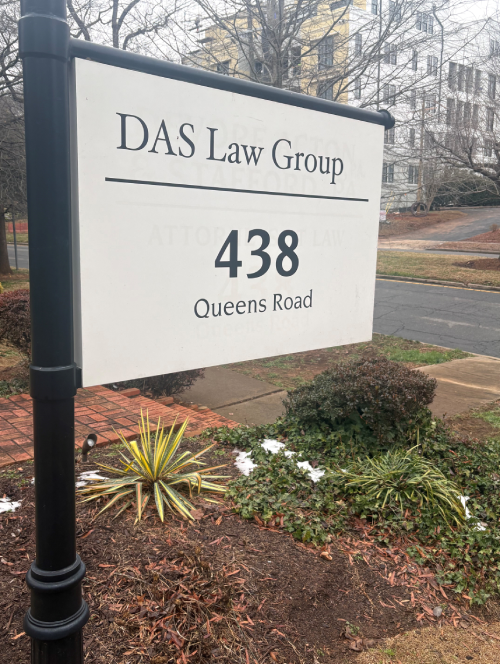
office location
DAS Law Group
438 Queens Road
Charlotte, NC 28207
fax:
704-332-2825
Copyright © 2026 DAS Group, LLP. All rights reserved. Disclaimer | Site Map | Privacy Policy
*Images are obtained under license from Canva and other third-party stock image providers, with attribution included where required.
Digital Marketing By 